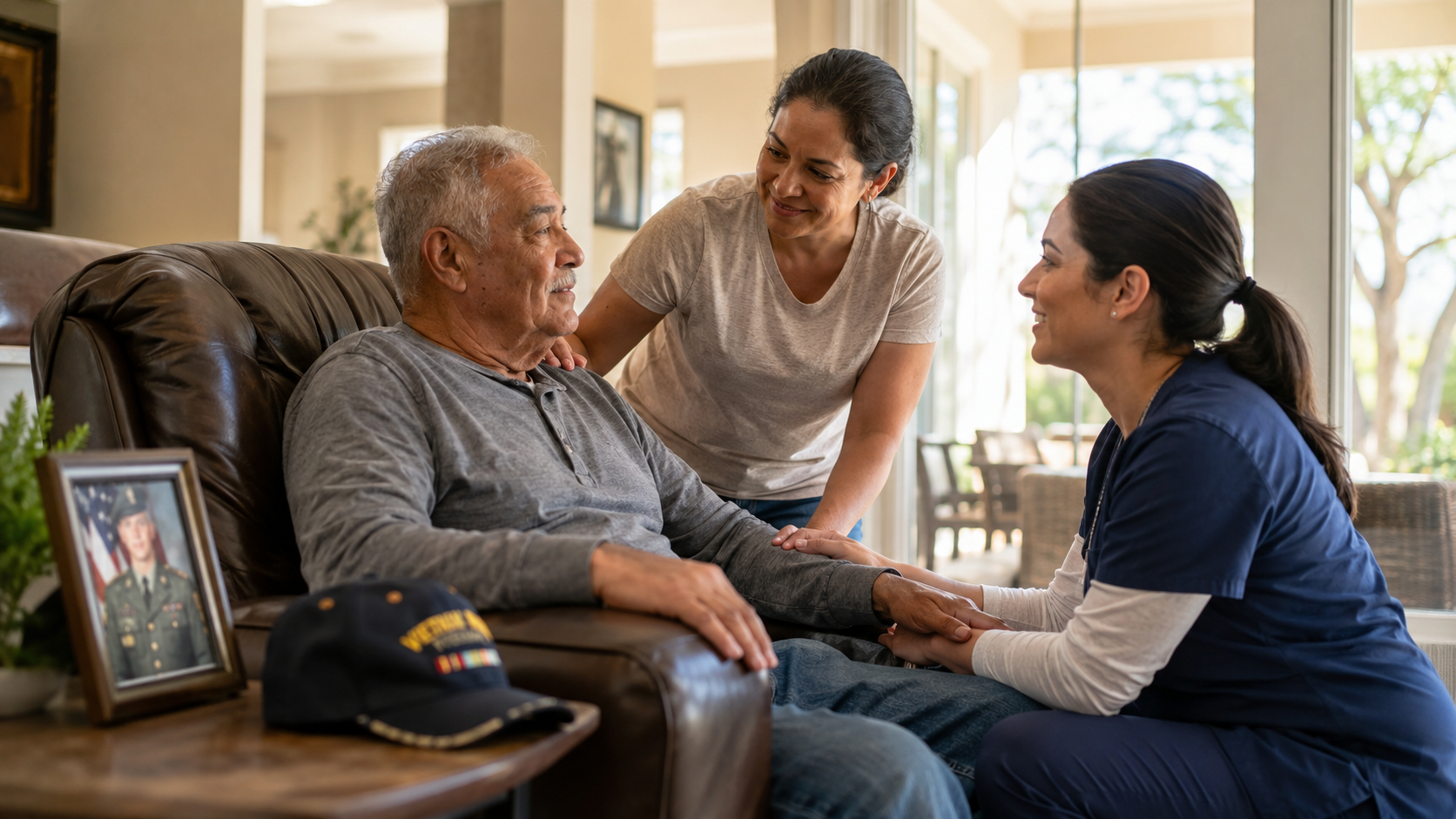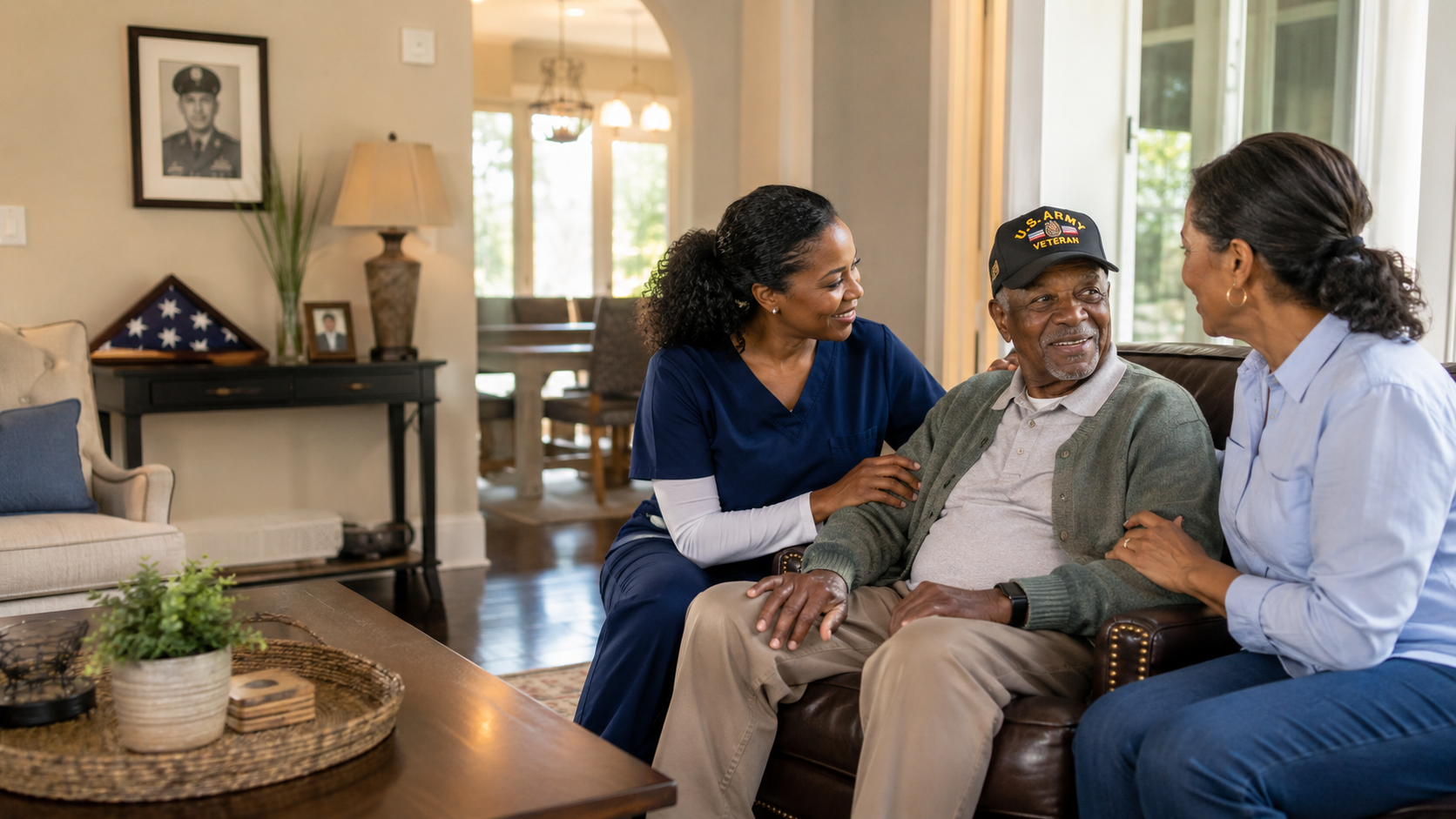
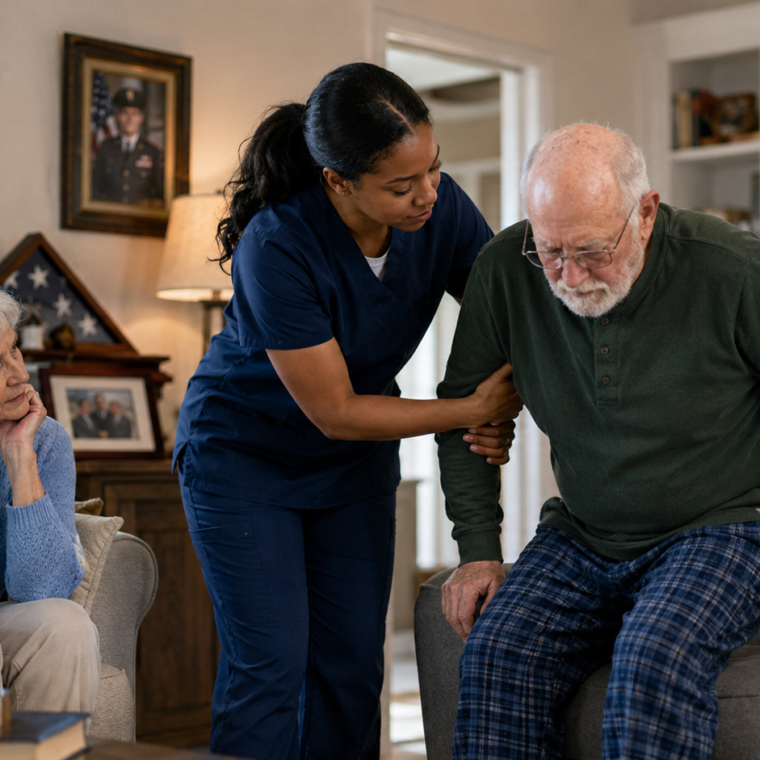

A Veteran can remain highly independent while daily life quietly starts requiring more help. A shower takes longer. Standing from a chair needs a steadying hand. Grocery trips disappear. A spouse stops leaving the house because they worry about what will happen if the Veteran is alone.
For families exploring in home care for veterans, the useful first question is not “Does this automatically qualify us for a VA benefit?” It is “What help is needed, how often is it needed, and what happens when that help is not available?” That creates a clearer conversation with the Veteran, the family, a VA social worker or care team, and any non-medical home care provider involved.
This article focuses on functional care needs. It does not determine VA eligibility. The U.S. Department of Veterans Affairs decides eligibility, authorization, and service availability under the rules of the specific VA program or service.
Quick Answer: What Kinds of Needs Make VA In-Home Care Worth Exploring?
VA guidance for Homemaker and Home Health Aide Care says the program is for Veterans who need personal care services and help with activities of daily living. VA examples include eating, getting dressed, personal grooming, bathing, using the bathroom, moving from one place to another, and grocery shopping. VA also notes that the program may be relevant when a Veteran is isolated or a caregiver is experiencing burden. Services are based on assessed needs and depend on applicable eligibility criteria and local availability.
The practical takeaway: if everyday tasks are becoming difficult, unsafe, inconsistent, or dependent on one exhausted family member, it is reasonable to document the pattern and ask the VA care team what home- and community-based options may fit. A functional need is a reason to investigate, not a guarantee of approval.
1. “Need” Is Not the Same as “Eligibility”
Families often collapse two different questions into one. The first is functional: “What can the Veteran do independently, and where is help now needed?” The second is administrative and clinical: “Does the Veteran meet the requirements for a particular VA service?”
The VA’s Veteran Decision Aid for Care at Home or in the Community starts with needs such as help eating, dressing, bathing, using the toilet, getting around the house, doing chores, fixing small meals, shopping, or receiving skilled care. The same tool states that eligibility is based on clinical need and service or setting availability. That is why a useful family assessment should describe what is happening without pretending to replace the VA’s decision process.
A Veteran may clearly need help at home while the family still needs to determine which VA program, community service, private pay option, or combination is appropriate. Keeping those questions separate improves accuracy and prevents benefit promises that no private company should make.
2. Bathing, Dressing, Grooming, and Toileting: Look at the Level of Help
Personal care is often where a small decline becomes visible first. The question is not simply whether the Veteran can technically complete a task. Ask whether the task is completed safely, consistently, and with a reasonable amount of effort.
- Bathing: Is the Veteran avoiding showers because getting in or out is difficult? Does someone need to stay nearby or physically assist?
- Dressing: Are buttons, socks, shoes, or changing clothes becoming hard to manage without help?
- Grooming: Are shaving, oral hygiene, hair care, or other routines being skipped because they now require too much effort?
- Toileting: Is getting to or using the bathroom becoming difficult, especially at night or when mobility is limited?
VA specifically includes dressing, grooming, bathing, and using the bathroom among examples of daily activities that may be addressed through Homemaker and Home Health Aide Care. On the private care side, Angels Instead provides personal care at home for routines such as bathing, dressing, grooming, toileting, and mobility. These are separate care pathways: Angels Instead can discuss non medical support needs, while the VA determines whether a VA service is authorized.
3. Eating, Groceries, and Daily Routines: Watch for What Has Quietly Disappeared
Not every care need begins with hands-on personal care. Sometimes the signal is a routine that quietly stops happening. The refrigerator has very little food. Meals become snacks. Grocery trips are skipped because walking through the store is too tiring. The Veteran can prepare food in theory but rarely does it in practice.
VA lists eating and grocery shopping among examples of daily activities that may be supported under Homemaker and Home Health Aide Care. The VA decision aid also asks Veterans to consider whether they need help with chores, fixing small meals, paying bills, or shopping.
For documentation, avoid vague notes such as “not eating well.” Record what is observable: “Skipped lunch three times this week because no one was available to shop,” or “Needed help carrying groceries and preparing dinner on four days.” Specific patterns give a care team more useful information than labels.
4. Mobility and Transfers: Document the Task, Not Just the Diagnosis
A diagnosis does not tell you how a person moves through a real home. Functional mobility questions are more concrete: Can the Veteran rise from a chair? Get from the bedroom to the bathroom? Move between bed and wheelchair? Use a walker consistently? Step into the shower without rushing or grabbing unstable furniture?
If there have been falls, near-falls, sudden weakness, or a major change in mobility, those observations should be shared with the Veteran’s health care team. They should not be treated as an online eligibility shortcut. A sudden or severe change may also need prompt clinical evaluation.
When the need is non medical help with walking, transfers, or everyday movement, Angels Instead offers mobility assistance. The service should be described as support for movement and daily routines, not as a guarantee that falls will never occur.
5. Frequency Matters: “Sometimes” and “Every Day” Are Different Care Problems
Frequency changes the care problem. Needing help with one weekly shower is different from needing help with every transfer. A family that has evening coverage but no weekday help also has a different gap.
When you describe a care need, add three details: how often it happens, how much help is required, and what happens if nobody is available. For example:
- “I need someone nearby for every shower because stepping over the tub edge is difficult.”
This kind of detail also helps a family decide whether they need occasional visits, a regular weekly schedule, respite coverage, or a different level of clinical support.
6. Isolation Can Be a Care Need, Not Just a Social Preference
A Veteran may be physically able to complete many tasks and still spend long periods alone. Isolation matters because it can change how consistently routines happen and how much support a family caregiver must provide from a distance.
VA’s Homemaker and Home Health Aide guidance explicitly notes that the program may serve Veterans who are isolated. That does not mean loneliness by itself automatically qualifies someone for a particular service, but it is a relevant context to share with the care team.
If the practical need is conversation, shared activities, routine check-ins, or a regular caring presence, Angels Instead’s companionship care can be discussed as a non-medical option. The care plan should reflect what the Veteran actually enjoys and wants, rather than treating companionship as passive supervision.
7. Caregiver Strain Is Part of the Picture, But It Is Not a Standalone Guarantee
A family can keep a fragile care arrangement running for months by sacrificing sleep, work, appointments, weekends, and time with other family members. From the outside, the Veteran may appear to be “managing at home.” In reality, one caregiver may be holding the entire system together.
VA’s Homemaker and Home Health Aide guidance recognizes caregiver burden, and VA Respite Care is specifically designed to provide short-term relief for family caregivers of eligible Veterans. VA says Respite Care can be helpful when caregivers need a break, need to run errands, or need to be away for a few days, subject to applicable eligibility and availability rules.
Caregiver strain is worth documenting in concrete terms: missed work, inability to attend personal appointments, repeated overnight interruptions, physical difficulty assisting with transfers, or lack of reliable backup. Do not inflate the story. Accuracy is more useful than dramatic language.
For families who need temporary non medical coverage outside a VA arrangement or while exploring options, Angels Instead provides in-home respite care in its service area.
8. What Does NOT Automatically Prove VA In Home Care Eligibility?
Several facts may justify a conversation about support but should not be presented as automatic proof of VA eligibility:
- Being a Veteran by itself.
- Reaching a certain age.
- Wanting to remain at home rather than move to a facility.
- One isolated fall or difficult day.
- A family caregiver feeling overwhelmed, without considering the Veteran’s care needs and the specific program rules.
- A private online quiz or home care assessment.
- Needing non medical help from a private provider.
For Homemaker and Home Health Aide Care, current VA guidance says an enrolled Veteran may receive the service if the Veteran is eligible for community care, meets the clinical criteria, and the service is available. Other VA home and community based services can have different requirements.
9. Build a 7 Day Care Needs Log Before the VA Conversation
This is the most useful step families can take without trying to diagnose or self-approve anything. For one week, record what actually happens. A short log turns “Dad is struggling” into information a care team can discuss.
For each difficult task, capture six points:
- Task: What was the Veteran trying to do: bathe, dress, use the bathroom, eat, shop, walk, transfer, or complete another routine?
- Type of help: Did the Veteran need a reminder, someone nearby, setup help, physical assistance, or complete help?
- Frequency: Did it happen once, several times, or every day?
- Consequence: What happened when help was unavailable, task skipped, meal missed, routine delayed, or family member called away from work?
- Recent change: Is this new, getting more frequent, or roughly stable?
- Caregiver impact: Who currently provides the help, and is that arrangement sustainable?
Keep the log factual. “Needed help standing from the toilet twice today” is stronger than “mobility is terrible.” “Spouse woke three times to assist overnight” is more useful than “caregiver is exhausted.” Specifics reduce ambiguity.
10. Know When the Need May Be Clinical Rather Than Non Medical
Home care and home health care are not interchangeable. If the Veteran needs wound care, skilled nursing, therapy, or other clinical treatment, ask the VA care team whether a skilled service is more appropriate. VA describes Skilled Home Health Care separately from non-medical daily living support.
11. Questions to Bring to the VA Social Worker or Care Team
- Which VA home- or community-based service best matches the Veteran’s current functional needs?
- Do the documented bathing, dressing, toileting, eating, mobility, shopping, or isolation needs affect the care plan?
- What clinical assessment is required?
- Is the relevant service available where the Veteran lives?
- Does community care eligibility or a referral apply to this service?
- Could Respite Care help if the family caregiver needs temporary relief?
- What should the family do if the Veteran’s needs increase or become more clinical?
VA’s decision aid encourages Veterans to write down questions and bring them to a care team or social work conversation. The goal is not to arrive with the “right answer.” The goal is to arrive with a clear picture of daily life.
12. How the Angels Instead VA Benefits Checker Fits In
If your family is still trying to organize the situation, the Angels Instead 60-Second VA Home Care Benefits Checker can be used as an initial information gathering step. It should help prompt the next questions, not replace the VA’s eligibility or authorization process.
A sensible sequence is:
- Identify the daily tasks that are becoming difficult.
- Track the pattern for several days if the situation is stable enough to do so.
- Use the Angels Instead checker to organize benefit related questions.
- Discuss needs and possible VA services with the Veteran’s VA care team or social worker.
- Confirm eligibility, authorization, availability, and any applicable costs directly with VA.
- If non medical home care is needed, discuss the actual schedule and tasks with the selected provider.
How Angels Instead Can Support the Non Medical Care Plan?
Angels Instead provides non-medical home care for veterans and other adults in Texas service areas. Depending on the family’s needs, support can include personal care, mobility assistance, meal preparation, medication reminders, companionship, respite care, and other day to day assistance described on the company’s veteran care page.
The role is practical: identify which routines need support, determine when help is needed, and build a care schedule around the person’s preferences and family circumstances. Angels Instead does not replace a VA clinical assessment and should not promise that a Veteran will qualify for a VA benefit or that the VA will pay for a specific private care arrangement.
Frequently Asked Questions
What daily activities can signal that a Veteran may need in home support?
Common functional needs include help with eating, dressing, grooming, bathing, using the bathroom, moving from place to place, and grocery shopping. VA lists these as examples for Homemaker and Home Health Aide Care, but actual services depend on assessed needs and program requirements.
Does needing help with bathing automatically qualify a Veteran for VA home care?
No. Bathing difficulty is relevant functional information, but no single activity automatically guarantees eligibility or authorization. VA applies the criteria of the specific service and considers clinical need and availability.
Can caregiver exhaustion matter when discussing VA in home care?
Yes, it can be relevant. VA Homemaker and Home Health Aide guidance mentions caregiver burden, and VA Respite Care is designed to give eligible Veterans’ family caregivers temporary relief. Caregiver strain alone should not be presented as a universal qualification rule.
Can Angels Instead decide whether a Veteran qualifies for VA benefits?
No. Angels Instead can discuss non medical care needs and provide its benefits checker as a preliminary information tool. Official VA eligibility, authorization, and service decisions remain with the Department of Veterans Affairs.
What should we write down before calling the VA?
Record the task that is difficult, the type of help required, how often it happens, what occurs if help is unavailable, whether the need is changing, and how the current arrangement affects the family caregiver.
Take the Next Step With Better Information
If a Veteran is having more difficulty with personal care, mobility, eating, shopping, isolation, or other daily tasks, document what is happening. Use the Angels Instead VA Benefits Checker to organize questions, then confirm the appropriate pathway with the VA.
When you are ready to discuss non-medical home care tasks and scheduling, contact Angels Instead for a no obligation assessment or call 281-800-1800.
Editorial / Eligibility Disclaimer: Educational only; not a VA eligibility determination or professional advice. VA rules, availability, authorization, and costs can change. Verify requirements with the U.S. Department of Veterans Affairs.