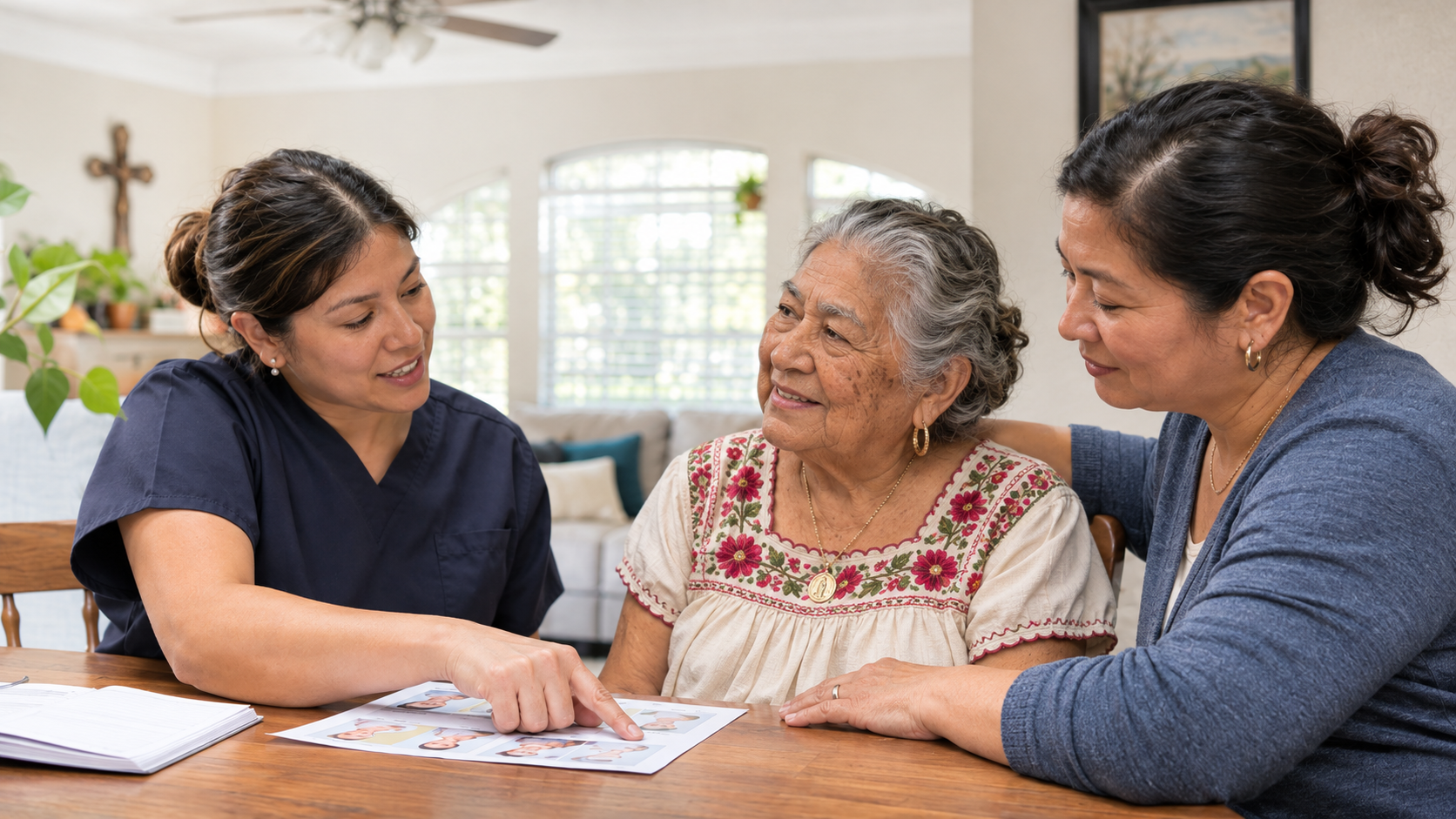



Quick answer: Ask the agency for its legal business name, Texas license number, office address and authorized service categories. Compare those details with Texas Health and Human Services (HHS) provider records. If you cannot establish the current status or the category of care, contact the state licensing office before making a commitment.
You have found someone who can help Dad get dressed, prepare breakfast and get around the house. The agency sounds promising on the phone. But before you give someone access to his home, how do you know the business is authorized to provide the care he needs? A license check is a practical first step, and it does not have to be complicated.
Does a home care agency need a license in Texas?
Under Texas Health and Safety Code Chapter 142, Section 142.002, businesses providing covered home health, hospice or personal assistance services for payment generally need a state agency license covering those services, unless a statutory exemption applies. The license pertains to the business directing the care, not simply the individual who arrives at your door.
Texas calls these providers Home and Community Support Services Agencies, or HCSSAs. The term covers different forms of care. Seeing it on a document does not by itself tell you whether the agency is authorized to provide the particular support your loved one needs.
Step 1: Ask for the information you need to verify
Start with the agency, not a general internet search. Ask the coordinator to provide the following details in writing so you can compare them with the state records:
- The legal name of the licensed business and any name it uses publicly.
- The Texas HCSSA license number and the office responsible for your care.
- The current license and authorized service categories.
- The contact details of the office that will supervise your caregiver.
A familiar brand name may differ from the legal name on a license. That difference is not automatically a problem, but the agency should be able to explain the relationship. If a company uses multiple offices, confirm which one will direct the services at your parent’s address.
Step 2: Check the official Texas provider records
Visit the Texas HHS HCSSA provider information page. It includes provider directories, closure information and state licensing contacts. Start with the directory and compare the agency name, identifying details and office information with what you received.
Texas HHS also provides a Long-Term Care Provider Search. You can reach it from the state’s long-term care information page. Search by the information available, such as the provider name or location. If the search does not load, the directory and licensing contact are useful alternatives.
A directory entry alone is not a guarantee that a license is currently active. Records can change. If you cannot establish current status, the authorized category or the correct office, ask the HCSSA licensing and certification office at 512-438-2630 for help.
Step 3: Match the service category to the care you need
The distinction matters more than the name printed on a brochure. A family arranging help with dressing has different needs from someone arranging skilled wound care.
- Personal assistance services: routine support with daily activities and independent living, including respite when appropriate.
- Home health services: clinical services within the provider’s authorization and the patient’s care plan.
- Hospice: specialized care for eligible people with terminal illness, under a separate service arrangement.
For example, Angels Instead describes its personal care services as help with bathing, dressing, toileting, meals and mobility. Ask the coordinator which tasks can be included in your loved one’s plan. A nonmedical caregiver is not a substitute for a nurse or therapist.
Step 4: Resolve discrepancies before care starts
Suppose the business name on the proposed paperwork differs from the name you find in the directory. Ask for the legal name, license number and an explanation of the relationship. If the office has moved or the record appears outdated, ask the state to clarify. Do not assume a missing search result proves an agency is operating unlawfully.
If someone presents an individual professional credential instead of the agency license, ask which business is responsible for providing and supervising the service. If the provider claims an exemption, ask for the basis and seek clarification from Texas HHS. Avoid signing or paying before material questions are resolved. If care is urgently needed, arrange appropriate interim support rather than leaving your loved one without essential assistance.
Step 5: Understand what a license does not prove
A state license is an important regulatory check, but it does not guarantee that a specific caregiver is a good match, that every task is covered, or that the agency can provide the hours your family needs. It is also not proof of Medicare or Medicaid participation. Confirm insurance arrangements separately, including whether any benefits apply to the service you intend to purchase.
Angels Instead’s caregiver services page publishes Texas HHS license number 021992 and describes its caregiver screening and supervision process. This is the agency’s own published information; families can request current licensing documentation and independently confirm the record with Texas HHS.
Once licensing questions are resolved, discuss your parent’s preferences, caregiver experience, the written care plan and the person responsible for supervision. Ask for the service agreement before committing to a schedule.
Houston example: Two agencies, one practical decision
Imagine a daughter in Houston arranging morning assistance for her father. Two agencies tell her they can help him bathe and dress. One provides a business name and license number immediately. The other uses a different name on its paperwork. Rather than choosing on price alone, she asks both providers to identify the licensed office responsible for his care and contacts Texas HHS to clarify the discrepancy. She then compares their proposed services and availability with her father’s preferences. This is an illustrative example, not an actual client case.
Before hiring: a quick verification check
- The agency’s identity and responsible office match the documentation.
- Current license status and applicable service category are established.
- Any discrepancies have been resolved with the agency or regulator.
- The proposed tasks and staffing meet the person’s needs.
Frequently asked questions
How do I verify a Texas home care agency license?
Obtain the legal name, license number and office information. Compare them with Texas HHS records and ask the licensing office to confirm any unclear details.
Is a caregiver certificate the same as an agency license?
No. An individual qualification and the authorization of a business to provide regulated services are different things.
Is an HCSSA license the same as Medicare certification?
No. State licensing and Medicare certification are distinct. Confirm each separately when relevant to your care or payment arrangements.
What if an agency is not listed in the directory?
Check spelling, legal business name and office details. Ask Texas HHS before concluding that the provider is unlicensed.
Does a license guarantee good care?
No. It is one important check. Also consider the person’s needs, caregiver suitability, supervision, communication and availability.
Do privately hired caregivers follow the same licensing rules?
Not necessarily. The law includes exemptions and different arrangements can have different obligations. Ask Texas HHS or a qualified adviser about your specific situation.
Can I ask Angels Instead for its license details?
Yes. Ask the care coordinator for current documentation and the service category relevant to your proposed care plan.
Talk with Angels Instead about your family’s care needs
If you are arranging care in Houston, contact Angels Instead to discuss daily assistance, caregiver availability and the documentation you need before making a decision. Call (281) 800-1800. Tell us what your loved one needs and ask which services can be arranged.